

Last Updated: October 23, 2026
Quick Summary
To organize tiny studio space, measure walls, door swings, and walkways before buying anything, then declutter category by category so storage fits what actually remains. Create sleep, work, and living zones with rugs or dividers, and choose renter-safe, multifunctional pieces that earn their floor space.
- Keep at least 60 cm clear between furniture edges so walkways stay passable.
- Turn hangers backward for a month to spot clothes you never wear.
- Place the bed as far from the entry door as possible, never facing it.
- Spend first on containment like bins and dividers, not new furniture.
- Label bins on the side facing out, since stacked bins hide top labels.
Table of Contents
- Before You Buy Anything: Measure and Plan Your Tiny Studio
- Small Apartment Decluttering Tips That Free Up Real Space
- How to Create Zones in a Studio Apartment
- Multifunctional Furniture for Small Apartments
- Small Studio Apartment Storage Ideas, Room by Room
- Budget Tiers: DIY Versus Buy
- Keep It Clutter-Free: A Simple Maintenance Routine
- Frequently Asked Questions
Before You Buy Anything: Measure and Plan Your Tiny Studio
Most people start with a shopping cart. That is the mistake. Before you learn how to organize tiny studio space, you need a tape measure and twenty minutes.
Small-space storage is the practice of using height, depth, and hidden areas to hold more in the same footprint. In a studio, that means walls, doors, and under-bed gaps, not floor space.
Here is what to record before you spend anything:
- Wall length of every clear wall, floor to ceiling
- Door swing for the entry, closet, and bathroom
- Window sill height and how far windows open
Write the numbers down. Tape them inside a cabinet door.
The Measurements That Decide What Fits
Two numbers kill most purchases: door swing and walkway width.
A closet or entry door that swings out needs clear floor in front of it. Measure the arc, then subtract it from your usable floor.
Walkways need room to pass: keep at least 60 cm clear between furniture edges, or the room feels cramped and you start sidestepping.
Height matters too.
Renter-Safe Installation and No-Drill Options
Renters cannot put holes in walls without losing a deposit. The fix is tension and adhesive.
- Tension rods inside a closet or alcove create a hanging rail with zero drilling
- Adhesive hooks hold light items like keys, totes, and small baskets
- Over-the-door racks add shelves and hooks without touching the wall
Small Apartment Decluttering Tips That Free Up Real Space
Decluttering comes first because storage cannot fix too much stuff. In a studio, every item you keep has to earn its floor space twice: once where it sits, and once where you stand to reach it. Small apartment decluttering tips work best as one sequenced pass, category by category, not room by room.
Run the Pass in This Order
Start with the categories that are easiest to decide and hardest to store; that builds momentum and frees space fastest.
- Clothes and shoes. Try the hanger trick: turn every hanger backward, and after a month anything still backward is a candidate to go. Bulky coats and off-season items go into vacuum compression bags, not back on the rail.
- Paperwork and mail. Keep a single document box with three folders: action, archive, and shred. Anything that does not fit a folder gets scanned or shredded the same day. Paper is the category that quietly eats a studio's only flat surface.
- Kitchen duplicates. Count your mugs, spatulas, and takeout containers. Most studios hold two to three times what one or two people use. Keep a service for your actual household size plus two guests, and donate the rest.
- Cables, chargers, and small tech. Group by device, label each pouch, and bin anything that fits no current device. This is where a multi-pocket organizer tote earns its place.
- Sentimental and undecided. Box it, date it, and store it out of sight. If you have not opened it in three months, donate the whole box unopened.
The Tiny-Studio Filter
Before anything goes back into the room, run it through three questions:
- Does it have a measured home? If you cannot name the exact shelf, drawer, or under-bed box it will live in, it is clutter waiting to happen.
- Does it do two jobs? In a studio, single-use items are the first to go. A decorative console with no storage is a table you already have.
- Would you rebuy it? If not, it is a donate candidate, not a storage problem.
What to Do With the Piles
Sort into four piles: keep and store, donate, recycle or bin, and undecided. Schedule the donate drop-off for the same week, not 'sometime,' or the pile becomes the clutter you just removed. For recycling, check your building's rules first; bulky cardboard and electronics often need a specific drop-off.
Keep the Result From Rebuilding
Give every kept item a home before the boxes come back in, and use the daily two-minute reset in the maintenance section to stop piles re-forming. Decluttering is a one-time event; keeping the floor clear is a habit.
How to Create Zones in a Studio Apartment
Zones are what separate a studio from a bedsit. To create zones in a studio apartment, divide one room into areas for sleeping, working, and living using furniture placement and visual cues rather than walls.
Three zones cover most studios:
- Sleep: bed, bedside surface, clothing storage
- Work: desk, chair, task light, cable management
- Live: seating, table, kitchen access
The trick is the boundary. A rug under the living area marks where one zone ends. A bookshelf placed perpendicular to a wall creates a soft divider without blocking light.
Where to Put the Bed in a Studio Apartment
Put the bed as far from the entry door as the room allows, and never directly facing it. That single move does more for the feel of the space than any storage product.
Good positions, in order of preference:
JOYBOS Touchless Trash Can with Motion Sensor & Auto Bag-Suction System →
- Against the longest wall, headboard centered, leaving both sides walkable
- In an alcove or corner, tucked so the foot of the bed faces open floor
- Behind a divider, shelf or curtain, to separate sleep from living
Avoid placing the bed under a window if you can. Drafts, light, and radiators all fight you there.
Multifunctional Furniture for Small Apartments
Every piece in a studio should do at least two jobs. Multifunctional furniture for small apartments is arithmetic: one item, two functions, half the floor. But the wrong two-job piece is worse than two simple ones, because it is heavier, harder to move, and often does neither job well.
The Pieces That Earn Their Space
- Storage ottoman: seat, footrest, and blanket box. Check the lid hinge; a soft-close lid matters if it doubles as a coffee table.
- Bed with drawers or risers: sleeping plus clothing storage. Drawer beds need clear floor at the foot or side to open, so measure the pull-out depth, not just the frame.
- Fold-down desk: workspace that vanishes at dinner. Wall-mounted versions need studs or heavy-duty anchors; freestanding ones need a wall to lean on.
Check the Fit Before You Buy
Most studio furniture returns happen for two reasons: the piece blocks a walkway, or it cannot get through the door and stairwell. Before you order, record these numbers:
- Doorway width and height at the entry, and the tightest turn in the stairwell or hallway. A sofa that fits the room but not the stairwell is a costly mistake.
- Walkway clearance. Keep at least 60 cm clear between furniture edges, or you start sidestepping.
- Door swing arcs for the entry, closet, and bathroom. Subtract each arc from your usable floor before you place anything.
Buy in This Order
Spend in order of impact, replacing the piece wasting the most floor space first.
- The bed. It is the largest object in the room and the biggest storage opportunity. Risers and under-bed boxes are the cheapest upgrade; a drawer bed is the bigger spend.
- The entry. A storage bench with hooks above it turns the first meter inside the door from a clutter drop into a working zone.
- The desk. A fold-down or wall-mounted desk frees floor during the hours you are not working.
- Seating and tables. Nesting tables and a storage ottoman come last because they are the easiest to live without while you save.
The Trade-Offs Nobody Mentions
Multifunctional furniture is heavier and often pricier than the single-use version. A sofa bed is a worse sofa and a worse bed than either alone; buy it only if guests are frequent. A storage ottoman with a stiff lid is a poor footrest. Decide which job matters more, and accept the other will be adequate rather than excellent.
Small Studio Apartment Storage Ideas, Room by Room
Storage in a studio is won in specific spots. These small studio apartment storage ideas go room by room, starting where clutter collects fastest.
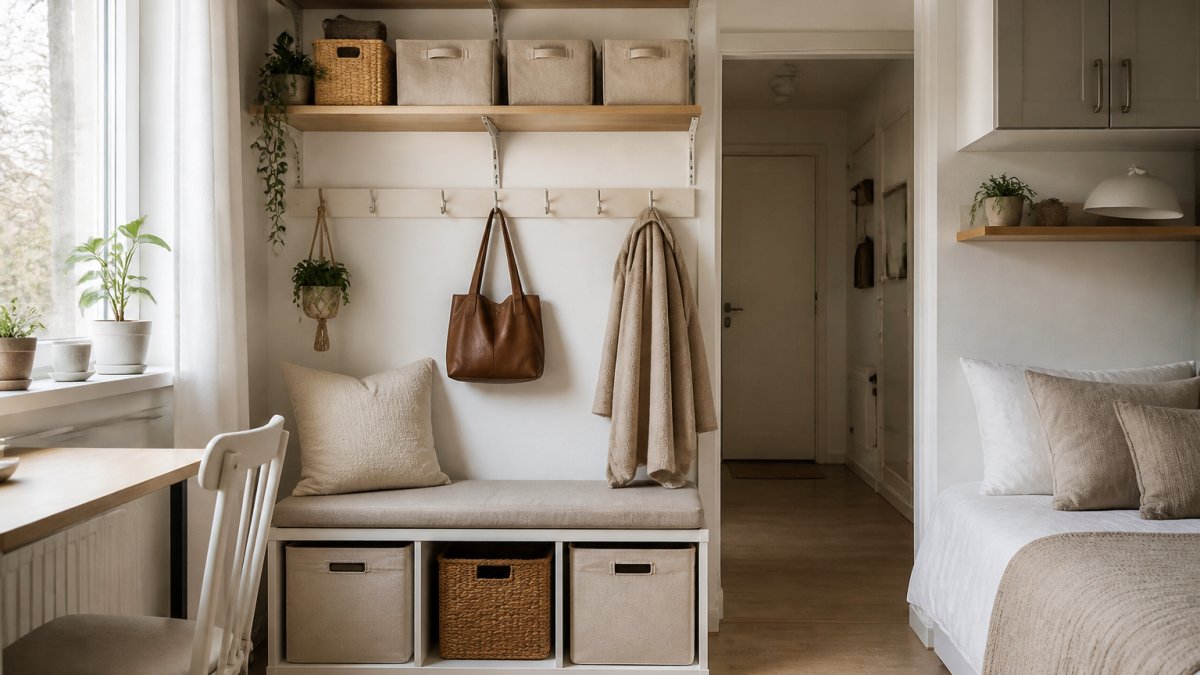
Entryway, Closet, and Under-Bed Storage
The entry is the first place clutter lands. Give it a landing spot.
- Hooks at shoulder height for keys, bags, and coats
- A storage bench with space underneath for shoes
- A small tray or bowl for keys and mail
Inside the closet, go vertical: a second hanging rail doubles shirt space, stackable bins on the top shelf hold off-season items, and a shoe rack beats a floor pile.
Under the bed is the largest unused area in most studios. Belily & Co. carries a 16-pack travel vacuum storage bag set with an electric air pump that works for both closet and suitcase.

Kitchen and Bathroom Storage
Kitchen counters fill up first. Go up, not out.
A countertop organizer rack lifts the microwave or oven and adds a shelf and pull-out drawer underneath. Belily & Co. stocks a microwave stand with a sliding drawer that does exactly this, holding appliances on top and tools below.

The bathroom needs less. A compact touchless trash can for small spaces fits narrow gaps and keeps hands off the lid.

Budget Tiers: DIY Versus Buy
Spend in order of impact, not in one trip. Here is the sequence.
| Tier | What to do | Typical approach | Impact |
|---|---|---|---|
| Free | Declutter, rearrange, measure | Sort and donate first | Highest |
| Low | Tension rods, adhesive hooks, risers | No-drill, renter-safe | High |
| Mid | Bins, totes, drawer dividers, labels | Group and contain | Medium |
| Higher | Multifunctional furniture, shelving units | Replace single-use pieces | Medium |
| Optional | Compression bags, counter racks, organizers | Squeeze specific zones | Situational |
DIY beats buying for anything you can build from a tension rod or shelf bracket, or solve with a cardboard box plus a label. Buy when the item replaces floor space or does two jobs at once.
Keep It Clutter-Free: A Simple Maintenance Routine
Storage fails slowly. A routine keeps it working.
- Daily, two minutes: return items to their zone before bed
- Weekly, ten minutes: clear the entry surface and kitchen counter
- Monthly, thirty minutes: check the undecided box and the under-bed storage
One rule does most of the work: everything gets a home. If an item has no home, it becomes clutter within a week.
A tiny studio does not stay organized by accident. It stays organized when every item has a measured home and every zone has a clear edge. Belily & Co. stocks the pieces that make that easier: space-saving vacuum storage bags, countertop racks, pull-out cabinet organizers, and compact bins built for narrow spaces.
Frequently Asked Questions
How do you organize a tiny studio apartment without it feeling cramped?
Start by measuring the room and clearing out what you do not use, then build upward. Wall shelving, stackable storage, and under-bed storage add capacity without eating floor space. Group items by activity so each zone holds only what belongs there. Choose furniture that does two jobs, such as a storage bench or a loft bed with drawers. Keep surfaces mostly clear and use matching fabric bins and storage totes so the space reads calm rather than crowded. A short weekly reset keeps it that way.
How can you create separate zones in a studio apartment?
Use furniture placement rather than walls. A shelf unit or bookcase set perpendicular to the wall can separate a sleeping area from a living area without blocking light. Rugs define the living zone, while a desk facing a window marks the work zone and keeps it distinct from the bed. Keep each zone's storage inside that zone so items do not migrate. An intentional layout with clear walking paths between zones makes a small studio feel like several rooms.
What multifunctional furniture works best in a small studio?
Look for pieces that replace two items you would otherwise buy. A loft bed or Murphy bed frees the floor area a regular bed occupies. A storage bench near the entryway doubles as seating and a drop zone for shoes and bags. A countertop organizer with a pull-out drawer, like the Belily & Co. microwave stand, adds vertical storage over a small appliance. Bed risers with under-bed storage bins are a low-cost option that uses space you already have.
How do you add storage to a small studio apartment as a renter?
Choose options that do not require drilling. Tension rods work inside closets, under desks, and in narrow gaps. Over-the-door hooks and organizers use closet doors and entry doors without hardware. Freestanding shelving, stackable storage boxes, and storage benches need no installation. Bed risers create under-bed space for storage totes. For clothes and bedding, vacuum compression bags shrink bulky items so they fit into a closet or suitcase. Measure doorways and clearances before buying anything large.
